 Copse & Compass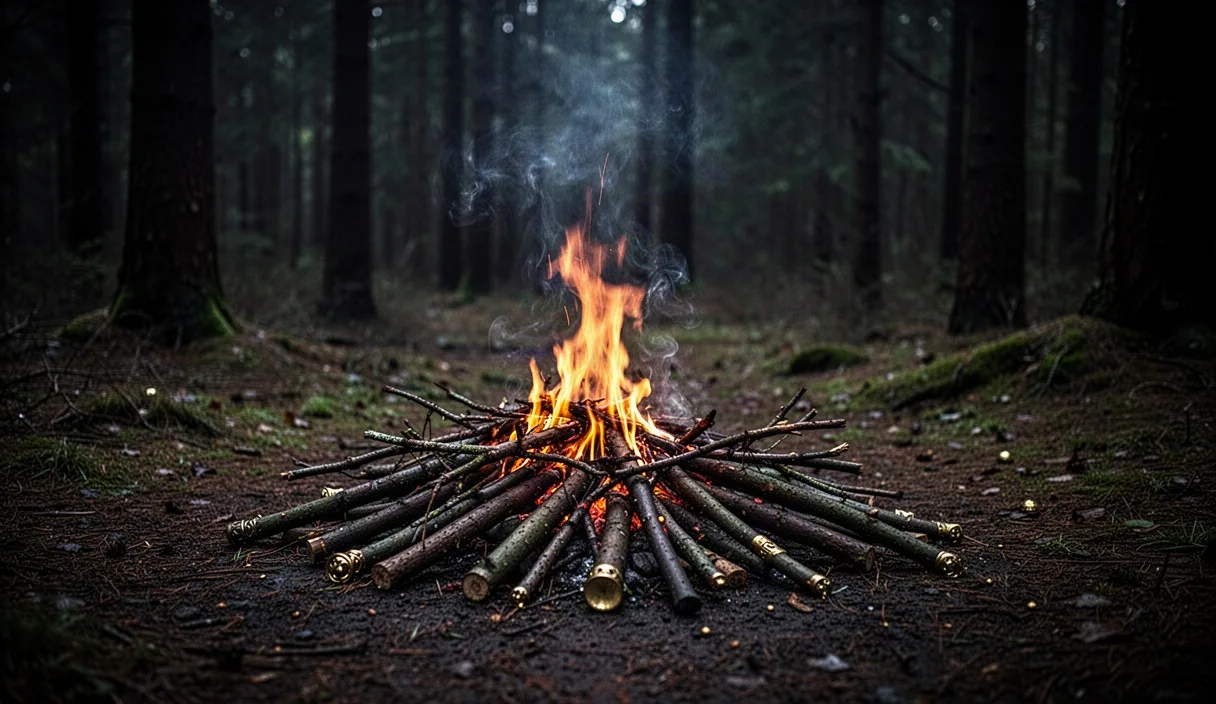

Rain has a way of soaking into everything in a woodland, not just the ground and the leaves but your matches, your resolve, and eventually your temper if you don't have a plan. We've built fires in downpours, in that fine drizzle that seems to get into every seam of a jacket, and on mornings after a night of steady rain when the whole wood smells like a wrung-out sponge. It's doable. It just asks for a different approach than the campfire you'd build on a dry August evening.
This guide walks through what actually works when the wood is wet, the ground is wet, and the air itself feels wet. None of it is complicated, but the order you do things in matters more than usual, and skipping a step tends to cost you twenty frustrating minutes later.
Why fire-building changes completely when everything is wet
Fire needs three things: fuel, oxygen, and heat, and wet conditions attack all three at once. Damp fuel wastes your flame's energy boiling off water before it can even start burning the wood itself. Wet, compacted air holds more moisture, which cools your flame faster than dry air does. And a soaked woodland floor pulls heat downward into the ground, which is why a fire that seems to catch nicely can fizzle out within minutes if it's sitting on cold, sodden soil.
The other change is psychological as much as practical: in wet conditions you get far fewer attempts before your tinder and kindling are used up or ruined. On a dry day, a failed match just means you strike another one. In the rain, every dry twig you find is precious, so the sequence of steps has to be right the first time.
We've found the difference between a fire that catches and one that doesn't usually comes down to preparation done before you strike anything, not clever tricks during the lighting itself.
Finding dry tinder in damp woodland
Rain falls downward, so the first rule is to look up, not down. The forest floor is the last place to find dry material after rain; the canopy and standing deadwood are the first.
- Standing dead branches still attached to a tree, especially conifers, often stay dry inside even when their surface is wet. Snap one and check the core.
- Birch bark peels off in papery curls and contains natural oils that let it burn even when damp. It's one of the most reliable tinders in a wet wood.
- The underside of dense evergreens like spruce or fir often stays sheltered from rain for hours after a downpour starts. Dead twigs there, no thicker than a matchstick, are usually bone dry.
- Fatwood from old pine stumps, the resin-soaked heartwood, will burn even soaking wet if you shave it into curls.
Man-made backup tinder is worth carrying rather than relying on, especially in a wetland or coastal woodland where dry natural material can be genuinely scarce. Cotton wool soaked in petroleum jelly, a candle stub, or commercial fire tabs from an outdoor shop will buy you the extra thirty seconds of flame that damp kindling needs.
Collect three times more tinder than you think you'll need. In wet conditions, a good third of what looks dry will turn out to have hidden moisture once you try to light it.
Choosing and preparing your fire lay
Ground choice matters more in wet woodland than dry. Avoid hollows where water pools, and avoid sitting the fire directly on saturated leaf litter, which will steal heat and can smoulder unpleasantly rather than burn clean.
Build a raised platform if the ground is properly wet, not just damp. Lay down a base of green sticks, roughly finger-thick, side by side like a small raft, then a second layer crossed over the top. This lifts your fire off the cold, wet soil and gives early flames a chance to establish before they meet ground moisture.
A log cabin lay or a lean-to lay both work better than a simple teepee in wet conditions, because they hold their shape better under wind and let you tuck tinder into a sheltered pocket rather than an exposed peak.
| Fire lay | Best for wet woodland when | Drawback in wet conditions |
|---|---|---|
| Teepee | You have very dry tinder and little wind | Collapses easily in rain or wind before it catches |
| Log cabin | Wood is only slightly damp and needs steady airflow | Slower to build, needs more prepared sticks |
| Lean-to | Rain or wind is coming from one direction | Only shelters the tinder from one side |
If you have a poncho, tarp, or even a large piece of bark, rig a simple shelter above the fire lay while you build it, not over the whole fire once lit. This keeps rain off your tinder during the vulnerable minute between striking a spark and getting real flame.
Feathering and splitting damp wood
Feather sticks are the single most useful skill for wet woodland fire-building. Take a stick that's wet on the outside, and with a knife, shave thin curls along its length without cutting them off completely, so they stand up like a bristly collar. The outer wet layer gets shaved away, and the dry wood underneath is exposed in a form that catches easily.
Split, don't just shave, thicker branches. A branch cut in half lengthways with a knife and a baton (a sturdy stick used to hammer the knife through) exposes a dry core that's often untouched by the rain, even after hours of steady downpour. This is usually more reliable than trying to peel bark off a whole branch.
Work in graded sizes: pencil-thin, then finger-thin, then thumb-thick, then wrist-thick. In wet conditions this grading matters more than usual because damp kindling needs a longer, steadier burn from the smaller stuff before it will accept anything thicker.
A folding saw is genuinely worth carrying for this reason. Cutting cleanly through damp deadwood to get at a dry core is far easier with a saw than trying to break it by hand, which tends to leave you with wet, splintered pieces rather than clean dry ones.
Getting the fire from spark to steady flame
Lighters and matches are far more reliable than a ferro rod in genuinely wet conditions, so carry more than one ignition method and keep at least one in a waterproof container. Storm matches, which burn longer and hotter than standard ones, are worth the extra cost for exactly this situation.
Build your tinder bundle into a loose nest, not a tight ball. Air needs to move through it. Hold your flame to the base of the nest rather than the top, since fire naturally wants to climb upward through the fuel.
Once the tinder catches, resist the urge to add wood immediately. Give it ten to fifteen seconds to build a small bed of embers and steady flame first. Adding kindling too early to a fragile flame is one of the most common ways a fire gets smothered before it's properly started.
- Light the tinder nest at its base.
- Add pencil-thin feathered sticks once flame is steady, a few at a time.
- Add finger-thick sticks once the pencil-thin layer is fully alight.
- Build up gradually to thumb and wrist-thick wood, never skipping a size.
- Only add larger, unsplit damp logs once you have a solid bed of coals.
Keeping the fire going in drizzle or wind
A fire that's caught can still die if you don't manage it through ongoing rain. Build a simple cover, a tarp pitched at an angle a good arm's length above the flames, or a thick roof of leafy branches propped on sticks. Never seal the fire in completely; it still needs airflow.
Keep a dry reserve of kindling and split wood under shelter near the fire at all times, not just for the initial lighting. Wet woodland fires are hungry for dry material continuously, since even wood that's been sitting near the flame for twenty minutes can reabsorb moisture from wet air if the wind shifts.
In wind, orient your fire lay so the open side faces away from the gusts, and build a low windbreak from stacked green logs or a bank of earth on the exposed side. Wind that's merely annoying on a dry day can genuinely blow out a young wet-weather flame.
Feed little and often rather than piling wood on. Two or three pieces added every few minutes keep the fire's core hot enough to dry out incoming damp wood as it burns, which is really the mechanism that keeps a wet-weather fire self-sustaining once established.
Common mistakes
- Using only surface tinder. Anything lying on wet ground has almost certainly absorbed moisture, even if it looks dry.
- Building too small a tinder reserve. Running out mid-attempt in the rain often means starting the whole search again from scratch.
- Piling on wood too fast. A young flame in wet conditions is fragile and easily smothered by well-meaning overfeeding.
- Ignoring the ground. Lighting directly on saturated soil or leaf litter steals heat and can leave you with smoke and no flame.
- Sealing the fire under a tight shelter. Cutting off airflow to keep rain out will suffocate the fire just as surely as the rain would.
Putting it out properly and checking the site
Wet woodland fires can be deceptively persistent underground, especially if you built on a raised platform with a base of sticks that's now partly charred. Douse thoroughly with water, stir the ashes with a stick, and douse again. Do this even if rain is already falling, since surface rain doesn't reliably reach embers buried under ash.
Feel the ashes with the back of your hand, not your palm, held close rather than touching, to check for lingering heat before you leave. If any part feels warm at all, add more water and stir again.
Dismantle any raised platform sticks and scatter them once cooled, rather than leaving a fire-scarred patch behind. If you're on managed woodland or a campsite, check whether there are specific rules about fire sites, since some areas ask you to use only designated fire rings for exactly the reasons of ground damage and fire risk, and it's worth asking a warden or site manager if you're unsure.
Next steps
Try practising the feather stick and split-wood technique at home on ordinary garden branches before you need it for real; it's a skill that improves fast with a bit of repetition and is hard to learn for the first time in a downpour. Pack a small dry-tinder kit into your rucksack permanently, even for day walks, since wet woodland conditions can turn up with little warning. And if you're heading somewhere with fire restrictions, or you're not sure about local rules on open fires, check with the landowner or local ranger service before you strike a single match.