 Copse & Compass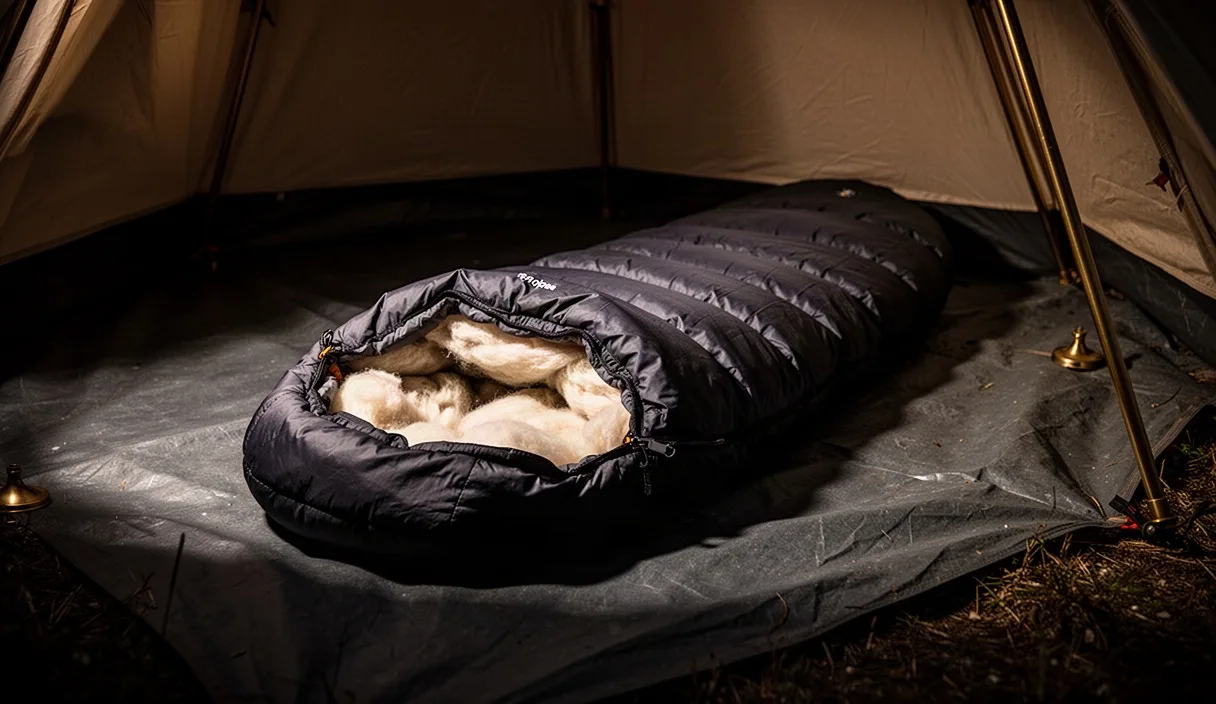

If you've ever stood in a gear shop staring at two sleeping bags with the same temperature rating but a $150 price difference, you know the down versus synthetic question isn't just gear-nerd trivia. It's a real decision that affects how much you carry, how warm you sleep, and how much you spend before you even get to the campsite.
We've slept in both types on trips ranging from dry autumn weekends to soggy spring trips where the tent floor never quite stayed dry. Neither fill is "better" in every situation, but each one clearly wins in certain conditions. This guide breaks down what actually matters for weekend camping, not thru-hiking extremes, so you can pick the bag that fits your trips instead of someone else's.
How down and synthetic fill actually differ
Down fill comes from the soft plumage found under the feathers of ducks or geese, usually geese for higher-quality bags. Those tiny clusters trap air in thousands of small pockets, and that trapped air is what actually holds in your body heat. The more the down can expand, called "loft," the warmer the bag for its weight.
Synthetic fill is made from polyester fibers, either short staple fibers or continuous filament strands, that are woven or bonded into batting. Instead of natural clusters, synthetic fill relies on the structure of the fibers themselves to create air pockets. It's a manufactured mimic of what down does naturally, and it gets close, but not identical.
Down is rated by fill power, a number like 550, 650, or 800 that tells you how many cubic inches one ounce of down will loft to. Higher fill power means more warmth per ounce. Synthetic bags don't use fill power ratings because the fibers behave differently, so you compare synthetic bags mainly by their listed temperature rating and total fill weight instead.
Both fill types are usually wrapped in a nylon or polyester shell with a durable water repellent (DWR) coating, so the outer fabric behaves similarly regardless of what's inside. The real differences show up in performance, not construction.
Comparing warmth-to-weight ratio
This is where down earns its reputation. A 650-fill down bag rated to 20°F typically weighs around 2 to 2.5 pounds. A synthetic bag with the same 20°F rating often weighs 3.5 to 4.5 pounds. That's roughly a pound and a half difference, which matters a lot if you're carrying it several miles to a backcountry site, but matters much less if you're driving to a campground and walking 200 feet from the car.
Higher fill power down, like 800 or 900, pushes the weight savings further. An 800-fill 20°F bag can weigh under 2 pounds. But that efficiency comes at a cost, both in dollars and in how the bag behaves when wet, which we'll get to shortly.
For weekend car camping, the weight difference rarely matters enough to justify the price gap. For weekend backpacking trips where you're carrying everything for two or three days, that pound and a half can be the difference between a comfortable pack and one that leaves your shoulders sore by Saturday afternoon.
| Bag Type | Typical Weight (20°F rating) | Approx. Price Range |
|---|---|---|
| 650-fill down | 2 to 2.5 lbs | $180 to $280 |
| 800-fill down | 1.6 to 2 lbs | $300 to $450 |
| Synthetic | 3.5 to 4.5 lbs | $80 to $160 |
Packed size and how it affects your bag
Down compresses smaller than synthetic fill because those natural clusters collapse more tightly and spring back reliably. A 20°F down bag might pack down to the size of a large loaf of bread, roughly 8 inches by 13 inches. The same-rated synthetic bag often packs to something closer to a small watermelon, maybe 10 inches by 18 inches.
This matters more than people expect once you're trying to fit a sleeping bag, sleeping pad, food, and clothes into a 45 to 65 liter backpack. A bulkier synthetic bag can eat up a third of your pack space, forcing you to strap gear on the outside or upgrade to a bigger pack than you'd otherwise need.
For car camping, packed size is mostly irrelevant since you're not hauling it anywhere except from the trunk to the tent. If your trips are entirely car-based, this section shouldn't weigh heavily in your decision at all.
Performance in damp or humid conditions
This is the down side of down, so to speak. Down loses most of its insulating power when wet because the clusters collapse and can't trap air anymore. A soaked down bag can feel more like a wet blanket than an insulator, and it can take a full day of sun and airflow to dry out completely in the field.
Synthetic fill keeps a meaningful portion of its insulating ability even when damp, because the fiber structure doesn't collapse the same way. It also dries noticeably faster, often within a couple of hours near a campfire or in direct sun, compared to most of a day for down.
Many modern down bags now use a hydrophobic treatment on the down clusters themselves, which helps them resist moisture longer before losing loft. It's a real improvement, but treated down still isn't as forgiving as synthetic fill in genuinely wet conditions, like a leaky tent or a multi-day rainy forecast.
If your usual camping spots are in coastal areas, rainforests, or anywhere with regular condensation and humidity, synthetic fill removes one variable you'd otherwise have to manage carefully. If you camp mostly in dry mountain or desert climates, this concern matters much less.
Cost and long-term durability
Down bags cost more upfront, sometimes double or triple the price of a comparable synthetic bag, but they tend to last longer if cared for properly. A well-maintained down bag can retain most of its loft for 10 to 15 years of regular use. Synthetic fill breaks down faster, usually losing noticeable loft after 3 to 5 years of regular seasonal use, because the fibers compress and don't fully spring back over time.
That means the cost gap narrows over the years. A $250 down bag used for a decade works out to about $25 a year. An $110 synthetic bag replaced every four years works out to about $27.50 a year, plus the hassle of replacing gear more often.
Budget matters too, though. If $250 upfront is a stretch but $110 isn't, the synthetic bag is the practical choice right now, even if the long-term math favors down. There's no shame in buying what fits your current budget rather than what fits a ten-year spreadsheet.
Care and storage for each type
Down bags need a bit more attention. Store them loosely in a large cotton or mesh storage sack, never compressed for long periods, since constant compression breaks down the clusters over time. Wash down bags only with a down-specific detergent, and dry on low heat with a few clean tennis balls in the dryer to help break up clumps as it dries. This can take two to three hours, so plan for it.
Synthetic bags are more forgiving. They can usually be washed in a front-loading washing machine with regular mild detergent and tumble dried on low heat. Storage is less fussy too, since synthetic fill handles compression better, though loose storage still extends its life somewhat.
- Down: store loose, wash rarely, use down-specific detergent, dry on low heat with tennis balls.
- Synthetic: can store compressed occasionally, wash with regular mild detergent, dries faster and more forgiving overall.
Both types should be aired out after every trip before long-term storage, even if they don't feel damp. Trapped moisture from body heat or morning condensation can lead to mildew smell in either fill type if packed away wet.
Which one fits your usual camping trips
If most of your camping is car camping at established campgrounds, weight and packed size barely matter, and a synthetic bag will likely serve you well for less money. If you're carrying your gear in on foot for more than a mile or two, the weight and packed size advantages of down start paying off quickly.
If you camp mainly in wet, humid, or coastal climates, synthetic fill's damp-weather performance removes a real risk. If your trips are mostly dry-climate weekends and you're willing to handle a bag a bit more carefully, down's warmth-to-weight ratio and longevity make it the stronger long-term investment.
Budget-conscious campers doing occasional weekend trips are usually well served by a mid-range synthetic bag. Frequent backpackers who camp several weekends a season in varied conditions often find that a treated 650-fill down bag offers the best balance of performance and cost.
Common mistakes
One common mistake is buying based on temperature rating alone without checking fill weight or fill power, since two bags with the same rating can perform very differently in practice. Another is compressing a down bag for storage between trips, which shortens its usable life far faster than most people realize.
Campers also sometimes assume a "waterproof" shell means the bag itself is waterproof. It usually just means the outer fabric resists light moisture, not that the bag survives a soaked tent floor. And washing a down bag with regular detergent instead of a down-specific cleaner can strip the natural oils that help the clusters loft properly.
Next steps
Think through your typical trip first: how far you carry gear, how wet your climate usually gets, and how often you camp each season. Match those answers against the comparisons above rather than choosing based on price or weight alone.
If you're still unsure, visiting a local outdoor gear shop and physically compressing both a down and synthetic bag of the same rating can make the difference click instantly. And if you're investing in a higher-end down bag, ask the retailer about their care instructions specifically, since fill treatments and shell fabrics vary enough between brands that a quick conversation can save you a washing mistake later on.